Saturday, October 22, 2011

Ancestry.com and Family Tree Maker

I have never hidden the fact that I don’t use Family Tree Maker. And even until recently, I have avoided using Ancestry.com. That was until recently, when I discovered a distant cousin sharing a family tree on the website which provided me with a few missing pieces of information. The principal reason for my lack of support of the website is that I tend to question the practice of sharing family trees so openly with other people. It is not that I have a concern with privacy (because tree setting allow for very good privacy especially on living people), it more of a concern that the information being shared is not actual fact. Perhaps a date of death was an approximate (aka “a guess”) and now this data is being passed around as if it is fact. Few people using the website are actually doing the leg work and will attempt to verify the information whether it is through source referencing or simply by asking the questions: “Where did this person get all of this information? Are they legit? Can their data be trusted?”

Despite being reeled into Ancestry.com, I still remain skeptical on information obtained from the website. And when I do find data, I verify sources and attempt to double-back and check on the data myself. However, despite this issue, there are plenty of positive aspects of Ancestry’s service such as its access to plenty of legitimate databases. To date, I have subscribed to the “paid” service of Ancestry.com for a number of months here and there, as I can not see the benefit of long term subscription with my current schedule. It anything, Ancestry.com has turned thousands of people onto an interest that love so that is a good thing. Also, I have just recently begun to use the family tree maker on the website which has turned me on to Family Tree Maker 2012, the popular family tree computer program.


So, I must now admit, publicly for the first time, that I like Family Tree Maker. Yes, I should have taken the advice of those fellow genealogists who repeatedly tried to sell me on the wonderful features of the program years ago. A few of those features that I enjoy is the ease at printing generation charts/reports and the ability to produce a calendar with all of the vital dates of your family tree. In minutes, I can have wonderful documents of my database. Plus, my family tree is saved as single computer file versus the 100+ files of my currently method.

Will I give up on my manual database and utilize Family Tree Maker? Probably not, but I will now enjoy maintaining two databases.

Monday, September 12, 2011

Seasons of the Genealogist

Seasons play a major part in our lives, not to mention their effect on sports and television. Genealogists are not immune to the seasonality of their interest. Maybe our seasons are not as well-known or noted on a calendar as they come and go, but for many researchers they are as real as the dates on your family tree (at least the dates your have confirmed yourself through years of work). Seasons may vary from genealogist to genealogist and likely vary from geographically locations, however I thought I would share the “Seasons of the Genealogist” for researchers in my neck of the woods…

Spring - This season is primarily the time where you start hitting those “roadblocks” that you have uncovered during those wintry days reviewing your family database. It’s still too wet outside to venture into cemeteries and some smaller archives/museums are still closed. By now, most of your relatives living nearby are tired of you and no longer find interest in your “exciting” stories of the past. The weather is better so you can now venture out to review collections at archives or libraries further away than that of your local library where by now the staff is well aware of your research and may even know your name. You’ve become such a familiar face that even amateur researchers are asking for your help with loading the microfilm reader. You now take pride in your speed at loading the microfilm reader and have even given pet names to a couple of the readers, like “Squeaky Susie” or “Dim-light Donna”.

Summer - Warm weather and green grass makes this the perfect season for touring cemeteries or making long trips to visit far-off relatives or distant archives. Many museums and archives now have extra staff so inquiries have a fast turn around time. This is the season of family reunions and other life events such as weddings where a family historian can easily talk with relatives and jot down names and dates on a napkin (get their phone number and call! Napkins disappear and make terrible reference material!). This is also the season where you must decide between yard-work or visiting a cemetery a few hours away… it’s a beautiful day for a drive; the lawn can wait! Plenty of sunlight allows for long days in the cemetery. By the end of this season, the cemetery groundskeepers are familiar with your car and tend to go in the opposite direction when they see you come.

Fall - The leaves are on the ground and the cold wind starts to blow. Life gets busy and your paperwork begins to pile up in your home office or research corner. Not only does Remembrance Day provide you with a time to share your family’s military history with other family members but it also marks the last time that you will likely be in a cemetery until spring. This season is also a time where you make visits to all of those family members that you made promises with during the summer. Hopefully they will provide a few tidbits of data or family photos that you have never seen before. On your trip back home from visiting a distant cousin you run into a snow storm… Duho! You forgot to put on winter tire on your car!! With school in, you receive a few requests from younger family members on material from their school project: their family tree. Oh how you wish you could be back in school and make that presentation because you know you would get a great mark with your material!! Sigh…

Winter - During the cold and snowy days of winter, time is spent inputting data into databases. On clear days, you might venture out to your local library and take a seat in front of a microfilm reader in search of a few “stranglers”. At the close of this season, you feel that you family database is nearly complete… then you find a section of your family tree that you did not notice before… what the!? You spend a few long nights sending information request via email but not all data can be found through email or letters. Now you have compiled a list of “research needs” and anxiously wait for the icy roads to clear and snow to melt away. It is during this season that you even ponder whether or not you could locate a headstone in a cemetery with 3 feet of snow on the ground (thankfully cemeteries are officially closed during this time or many researchers would like have been lost in snow drifts). Wait it out, this is what some call “cabin-fever”!

Monday, August 8, 2011

On The Book Shelf...

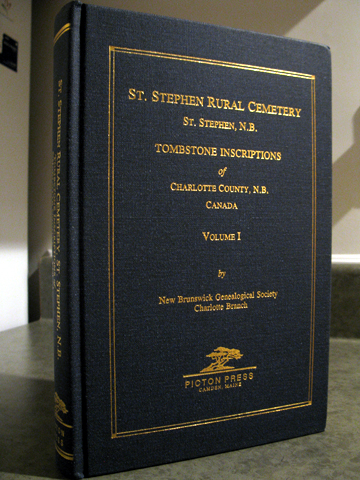
One book in my home library that sees heavy use is "St. Stephen Rural Cemetery, Tombstone Inscriptions of Charlotte County", by the New Brunswick Genealogical Society; published by Picton Press (1996). While working at the Charlotte County Archives one cold February morning, I came across this wonderful book. Expecting to open the front cover and see that this book was long out of print, I was happy to see that the book was a little over a decade old and perhaps still still available from the publisher. So I contacted Picton Press, located in Rockland, Maine, and found that the book was still available (though no longer in print) with only a few left on the shelf. This book is a must for anyone researching Charlotte County. An index at the back of the book points to vital information and a section-by-section map of the cemetery makes locating plots very easy. St. Stephen Rural Cemetery is perhaps the largest cemetery in Charlotte County and his book is an essential tool in my library. A job well done by the folks from the Charlotte Branch of the NBGS back in the mid-1990s! Keep in mind that the publisher is no longer printing this book, but they do have a few copies left. You can contact Picton Press via their website, http://www.pictonpress.com/.

Sunday, July 10, 2011

Happy Father's Day - Cemetery Book

I am not sure how many fathers would be delight to receive a book on cemeteries for Father’s Day but I certainly was! The latest book to my collection is “Old Canadian Cemeteries: Places of Memory” by James Irwin with photographs by John DeVisser (2007, Firefly Books. ISBN: 978-1-55407-146-3). This book is almost to big to be a reference book and plays more like a coffee table/picture book. However, don’t be fool. Mr. Irwin does a great job offering readers on the world of cemeteries. From burial methods to the various ages of headstones and headstone design. After reading this book, I discovered many items that I was unaware of. Thank you Mr. Irwin for delivery a very interesting book to us of "taphophilia" but a special thanks to my son and wonderful wife for the gift!

Old Canadian Cemeteries: Places of Memory”
Irwin & DeVisser; 2007, Firefly Books. ISBN: 978-1-55407-146-3